
Indicators of Forthcoming State-Sponsored Repression of Social Justice Movements Through Political Prosecutions
Introduction
State actors have been weaponizing the criminal legal system to target protesters, organizers, and movement leaders for generations. As advocates for inclusive democracy look at how to best respond to the latest waves of political prosecutions, and how best to inoculate movements against those attacks before they reach a fever pitch, it’s important to consider what confluence of factors may portend a forthcoming wave of legal repression.
Below is a look at some factors that make situations ripe targets by law enforcement and prosecutors for political prosecutions, based on conversations with those who have faced such attacks or who have helped defend those who have faced the attacks. This is not a perfect science: not every factor applies to every situation, or comes into play at the same time or in the same order. In fact, politically-motivated charges can be levied against protesters months, or even years, after a violent crackdown by police.
That said, this analysis provides a thoughtful baseline for advocates to consider both their level of risk and when to employ various tactics for pre-preparedness for legal repression.
“While we cannot prevent political prosecutions, we can take steps towards preventing them from becoming compounded by neglecting causal factors and manageable risks.”
A Comprehensive Approach for Responding to Political Prosecutions
Political prosecutions take many shapes. There are also different scales of impact. In order to have a shared framework for how to manage our collective efforts to defend movements, we build and adapt from the disaster management cycle of mitigation, preparation, response, and recovery.
Mitigate
Mitigation specifically refers to actions taken that can lessen the severity of a political prosecution’s impact. Investing in measures that limit hazards can greatly reduce the burden of state repression. While we cannot prevent political prosecutions, we can take steps towards preventing them from becoming compounded as a result of neglecting causal factors and manageable risks.
Examples of mitigation activities could include:
- Educate movement networks, legal formations, and journalists
- Reduce legal risks and financial exposure to movement, where possible
Prepare
Well-coordinated responses to political prosecutions require prior planning. This preparation helps ensure fast, effective response efforts and limits duplicated efforts to understand and anticipate the needs of movement formations impacted by political prosecutions.
Examples of preparation activities could include:
- Plan and train across movement scaffolding ecosystems and with national movement networks
- Pre-staging resources when conditions in jurisdiction are expected to result in political prosecutions
Respond
When a political prosecution begins, political-legal defense management focuses on delivering help and interventions that can save lives, safeguard activists, protect movement formations and organizations, and their funders.
Examples of response activities could include:
- Communicate - raise the alarm and activate response amongst practitioners and funders
- Coordinate national support to local leadership
- Confront criminal and civil legal attacks proactively and aggressively
- Counter political and media narratives
Recover
Recovery focuses on the restoration, redevelopment, and revitalization of movements after they have been impacted by a political prosecution.
Examples of recovery activities could include:
- Engage community & broaden coalitions
- Build (or rebuild) infrastructure (full time organizers, resources, movement lawyers, legal observers, etc.)
- Long-term mutual aid & legal support
With this framework in mind, we can begin to examine the leading indicators of a potential political prosecution, monitor its development over time, and judge its scale of impact.
Factors & Conditions
We recognize that predicting the circumstances that lead to political prosecutions is not a perfect science; there may be a confluence of factors, and those factors might be simultaneous.
Pre-existing Factors
Historical actions of various law enforcement and movement formations in the jurisdiction
- Fraternal Order of Police and similarly situated law enforcement PACs elect more people locally
- Police face recruitment challenges
- Far right embedded with / in collusion with law enforcement
- Movement specifically challenges police militarization
- Law enforcement opens files and conducts “assessments” on protesters, sometimes without following the proper channels / acting beyond their authority
- Movements utilize tactics outside of traditional political processes
- Pre Existing political prosecutions
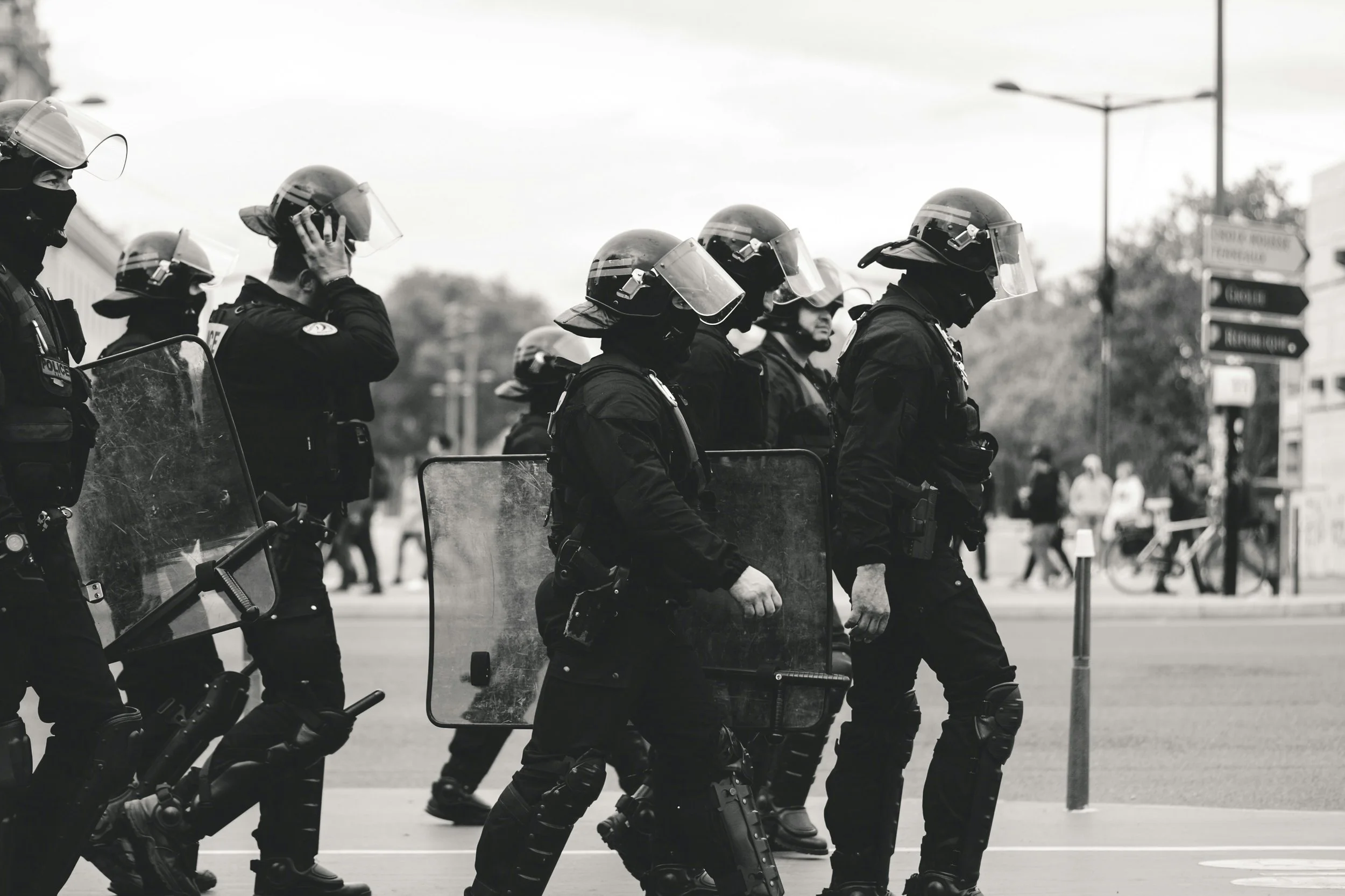
- Excessive force used against protesters
Private interests - corporations, universities, nonprofits - that are targeted or feel targeted by movement actions
- Alliances between governments and fossil fuel industries, weapons manufacturers. Litigation taking place against fossil fuel infrastructure. Greenwashing taking place, i.e. conversion of pipelines for expansion of carbon dioxide (CO2) transportation infrastructure.
- Law enforcement coordinate with private interests to protect themselves from public criticism
Political figures - sheriffs, prosecutors, mayors, governor, attorney generals - with media acumen, political ambition, and reactionary constituencies (not necessarily “right wing”)
- Political climate favors grandstanding. Elected leader senses a political opportunity in tamping down on, specifically, BIPOC protesters to promote copaganda and show White voters they are “tough on crime”
- Political leadership has recently transitioned from white to BIPOC officials, putting pressure on new government to show they are tough on crime.
- There is personal animus against the movement by an empowered leader such as a sheriff or district attorney
Photo by Elizabeth Frantz via reuters.com
Emerging Factors
Advancement of laws on the state or local level targeting protesters
Escalation of movement activity - sudden, unexpected, or different
- Young people willing to fight to have their voices heard
- There is a flareup of protest
Escalation of law enforcement and prosecutorial activity - sudden, unexpected, or different
- Police coordinates surveillance across jurisdictions, in partnership with state and federal officials
- Law enforcement outright admit their political agenda. State portrays protesters as people on the fringes of society, outside agitators, paid professionals, proxies for foreign forces, anarchists, irrational, un-American, terrorists or supporters of terrorism, etc.
- Court documents presented by the state may be half-baked, indicating the case is more about political grandstanding and media exposure than ensuring that charges stick
Increased media attention
- State utilizes hyperbole regarding protest actions, i.e. “burning the city to the ground,’ ‘inciting riots,’ etc.
- “Mainstream” voices, such as clergy or civic leaders, are trotted out by repressive forces to endorse their position that protesters are fringe
- Establishment forces now consider themselves on the defensive. Businesses sense their bottom line may be compromised
- There is a lack of a strong, unified, public-facing side of those who are discontented and protesting – this might be an ideologically misunderstood group. There is no unified comms strategy.
- State portrays a unified movement, even when it is a decentralized movement and/or a leaderless ecosystem with multiple factions and tactics – or state focuses on one aspect of the coalition while ignoring others, implying our explicitly stating that some protestors are legitimate while others are not
Photo by Leonard Zhukovsky via cityandstateny.com
Escalation Factors
Novel movement tactics, especially which increase intensity or are difficult for authorities to control
- May include civil disobedience, trespassing, and property damage
Pressure from private interests - revenue impacts, construction timetable, etc.
- Pressure transcends partisan politics – Centrist Democrats / technocrats endorse actions by Conservative forces, if they are not themselves leading the repression
- Businesses may be engaging private security to monitor protesters and share information with law enforcement
Political opportunism - an upcoming election, career building, etc - that motivates the classification and/or dehumanization of movement as a threat
- Elected officials begin traditional media and digital attacks on movement and place pressure on law enforcement to create further arrests and promote accompanying aggressive charges.
- State names protesters as terrorists or portrays them as members of a criminal enterprise with minimal pushback from those who in ‘mainstream’ political discourse
- Statewide officials mirror the language, indicating state resources may be marshaled to increase scale of repression
- Individual activists/leaders/organizations are named and blamed for fomenting agitation
Politicized media attention - partisan editorialization or propaganda of activities at regional/national level
- Extreme political right goads the state to act more aggressively towards protesters, possibly using right wing media outlets to amplify these calls
- Hearings seek to frame the debate and pressure more action by local officials
Drastic intensification of law enforcement and prosecution (violence, charges, bonds amounts, bonds being denied, revising arrest policies, etc.)
- Using militarized gear, police create confrontations at protests to generate arrests. As agents of the prison industrial complex, they seek to portray that they are taking action and solving the perceived problem against a violent movement
- Sudden disproportionate punishment: Protesters are held in jail. Bonds are high. State seeks jail sentences for protesters. State moves from misdemeanor prosecutions to felony prosecutions. State attempt to pick off defendants individually
Photo by Jose Luis Magana via cnn.com
Watch vs Warning
We want to establish a set of language that helps to decipher the complex, and often rapidly changing, dynamics across jurisdictions so that we can evaluate resource needs and tactical interventions to mitigate and prepare for political prosecutions - before they occur.
- Watch - Conditions for a political prosecution are possible.
- Warning - Conditions for a political prosecution are expected.
Stages of Political Prosecution
(Adapted from Ten Stages of Genocide)
If the majority of the above conditions are met, then it is highly likely that the first 4 stages have been met and stages 5 and 6 are underway.
- Classification – Law enforcement, prosecutors, politicians, or private interests begin using divisive ‘us’ and ‘them’ language using labels or stereotypes.
- Symbolization – Law enforcement, prosecutors, politicians, or private interests share “visual clues” for identification of movement that has been classified as a threat in order to have a chilling/marginalizing effect and clear target selection by reactionary non-state allies.
- Discrimination – The state denies civil rights to activist activities and incites movement reactions.
- Dehumanization – The state justifies violence in response to movement reactions building on prior classification and symbolism tropes.
- Organization - Political prosecutions are always planned. This moment of formation between the conspirators of a political prosecution will likely only be discovered after the fact.
- Polarization – The state implements a proactive communications plan that drives larger media narratives and propaganda begins to be spread by reactionary forces.
- Preparation – The organized group intent on political prosecutions begins to openly plan with other state and non-state actors. They often use euphemisms such as a “task force” or “operation”. They create fear of movement activities within the state, build up resources and personnel, and ensure political allies/private interests are informed.
- Persecution – The state draws up target lists - individuals, formations, and organizations. Surveillance extends beyond direct action sites or public meetings. Political prosecutions begin.
- Destruction – The state dismantles movement and destroys lives in a deliberate and systematic campaign of state violence.
- Denial – The state denies the existence of any bias, violence, or misconduct.
SEVERITY
It is helpful to understand the level of power that establishment forces are wielding against a movement when considering the specific resources needed -- and at what scale -- to respond effectively to the attacks, especially in a way that will make the attacks politically toxic in the future.
- Incident - An event involving the investigation, arrest, and/or prosecution of activists.
- Level 2 - An incident involving many activists on low-level charges.
- Level 3 - An incident involving some activists on significant charges
- Level 4 - An incident involving many activists on significant charges
- Level 5 - An incident with widespread and significant charges
