
Introduction
Dissent is the lifeblood of democracy. Yet the government has used many tools to quell dissent, and to weaken efforts that call out injustice and demand systemic change. One such tool is political prosecution – using the criminal legal system to target protesters, organizers, and movement leaders. Political prosecutions have been used historically as a major tool to deter Black people from engaging in their right to protest and weaken efforts to draw attention to issues impacting Black Americans
Stop Cop City, an effort by activists in Atlanta to stop the building of a militarized police training center, is the highest-profile example of current political prosecutions. In January 2023, police raided an encampment at the ‘Cop City’ construction site and killed Manuel Esteban Paez Terán, known as Tortuguita, an activist with their hands raised in the air when he was shot. Prosecutors later charged sixty-one of the people present that day under the Georgia RICO / racketeering law. Many also face domestic terrorism charges. The state is also targeting community bail fund organizers and working to shut them down by whatever means necessary, in collusion with the federal government.
State actors have been weaponizing the criminal legal system to target protesters, organizers, and movement leaders for generations. As advocates for inclusive democracy look at how to best respond to the latest waves of political prosecutions, and how best to inoculate movements against those attacks before they reach a fever pitch, it’s important to consider what confluence of factors may portend a forthcoming wave of legal repression.
Below is a look at some factors that make situations ripe targets by law enforcement and prosecutors for political prosecutions, based on conversations with those who have faced such attacks or who have helped defend those who have faced the attacks. This is not a perfect science: not every factor applies to every situation, or comes into play at the same time or in the same order. In fact, politically-motivated charges can be levied against protesters months, or even years, after a violent crackdown by police.
That said, this analysis provides a thoughtful baseline for advocates to consider both their level of risk and when to employ various tactics for pre-preparedness for legal repression.
Atlanta is not an anomaly; rather, it is an alarming sign of just how coordinated and out of control political prosecutions can be. Few people understand how common political prosecutions that target movements for racial, social, and environmental justice and human rights are today. Below is a snapshot of some of these stories from just the past few years. In these stories, a few themes emerge:
- Poitical prosecutions often take place following a militarized, aggressive, escalated police response at demonstrations
- Prosecutions often target protest organizers and movement leaders, sometimes after extensive surveillance and use of “informants”
- Law enforcement will fabricate affiliations that don’t exist – to gangs, to foreign countries, etc. – to further the political intention behind the prosecutions, and to sow division between movements
- Many protesters are charged with serious felony offenses that come with long legal battles that threaten their employment, housing, banking, parental rights, and freedom for years
- Whether it’s laws originally intended to prosecute organized crime bosses, mass murderers, or KKK organizers, law enforcement are increasingly attempting charges under statutes never previously applied to protesters
- The number of charges on the books designed to charge protesters has dramatically increased over the past few years – and prosecutors will sometimes choose the most punitive options
- Even when law enforcement knows these charges won’t stick, they use them to chill dissent, knowing that activists will be doxxed for months to come
- Some organizers face pretrial bonds being revoked when they are arrested on minor charges related to a protest, leading to prolonged detention
- Even when there is no pre-trial bond at issue, protesters are increasingly left languishing in jail with no possibility of bail
- Political prosecutions are happening all over the country – this is not an issue of blue states vs. red states or urban vs. suburban vs. rural.
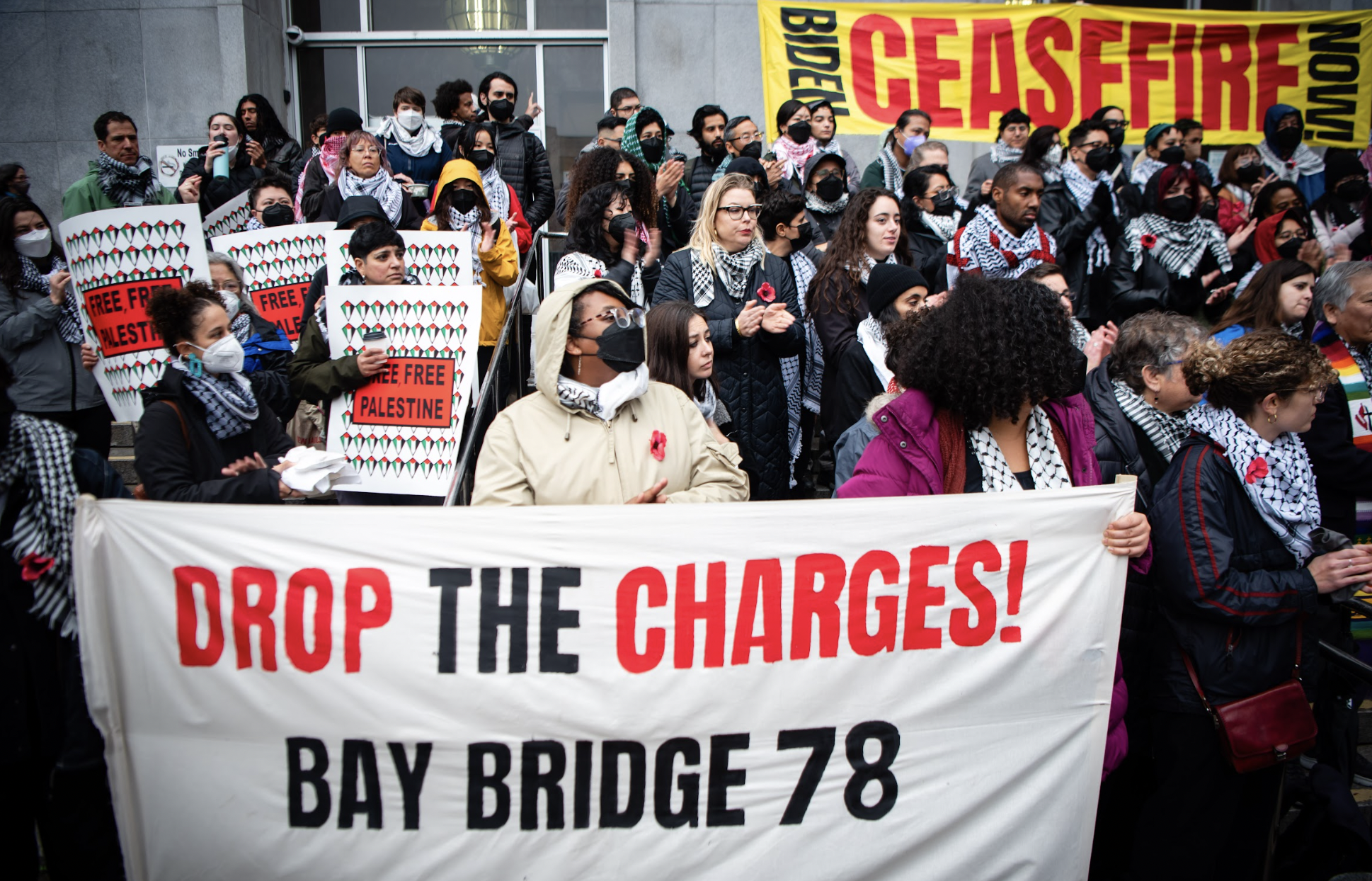
San Francisco, CA: Anti-Palestinian Bias Motivates Disproportionate Prosecution of Courageous ‘Bay Bridge 78’
In December 2023, San Francisco District Attorney Brooke Jenkins announced that 78 Palestinian human rights protesters would be charged for an act of civil disobedience blocking traffic on the Bay Bridge for nearly four hours a few weeks earlier, on a day when anticipated disruption to traffic was highly publicized. The charges include failing to obey a lawful order from a uniformed police officer, false imprisonment, unlawful assembly, refusal to disperse at a riot, and obstruction of a thoroughfare. Civil rights lawyers noted that charging protesters with false imprisonment for civil disobedience had not been seen before in San Francisco. Protesters could face anywhere between 6 months to a year in jail.
In February, Center for Protest Law & Litigation at the Partnership for Civil Justice Fund, the legal team representing the ‘Bay Bridge 78,’ sent a letter to DA Jenkins raising alarm over racist, anti-Palestinian statements made by a member of her office and the D.A. herself and calling for charges to be dropped over their bias.
The letter states, “On February 8, 2024, the San Francisco Standard published a series of emails from Assistant District Attorney Michael Menesini, who, using his San Francisco government email address, described Palestinians as “brutal Arab invaders,” “hate mongers,” and “Nazis” who need to be “sent back to their native homelands.” Not long ago, you characterized a peaceful San Francisco march, which called for a ceasefire in Gaza, as “pro-Hamas” and attributed anti-Israel graffiti to the protestors, despite there being no evidence linking the two.”
The legal team also filed a motion for the court to dismiss the charges in the interest of justice, stating: “The Bay Bridge 78 were taking actions of conscience to stop genocide by calling attention to their government’s facilitation of it and demanding an end and change in policy. The temporary inconvenience to motorists on the Bay Bridge, on a day when traffic delays were expected, pales in comparison to the mass slaughter, maiming, starvation, and destruction which continue to be inflicted on the 2.3 million people of Gaza with U.S. weapons and tax dollars. Protesting genocide serves the public interest. There is no public interest to be served by proceeding with this wasteful prosecution.”
San Diego, CA: Proud Boys Counter-Demonstrators Found Guilty of Conspiracy to Riot while Violent Fascists Go Uncharged
On Jan. 9, 2021, three days after the insurrection at the U.S. Capitol, a group of assorted Trump supporters, Proud Boys and members of the extreme right in San Diego, including people with a history of violence at local protests, marched around Pacific Beach shouting slogans and calling on anti-fascists to fight with them. Counter-demonstrators confronted the protesters. The result was a beachside brawl, during which rallygoers on the right flashed a knife and a BB gun, struck a reporter with a smoke grenade, and protesters on the left fired pepper spray.
A year later, the San Diego district attorney Summer Stephan, who has a history of peddling antifa conspiracy theories, announced charges against 11 individuals — all of them on the left. Instead of holding each defendant accountable for individual acts, it accuses them, and potential other “unidentified co-conspirators” of a prearranged conspiracy to riot – holding counter-protesters responsible for each other’s actions. Of the 11 original defendants, nine cut deals with prosecutors that saw some of them agree to multi-year prison sentences. Two Los Angeles residents, Brian Lightfoot and Jeremy White, decided to argue their cases before a jury. They were represented by civil rights attorneys, who told USA TODAY they took on the cases because of their potential impact on the broader anti-fascist movement.
Said Jeremy White: “This is a group of prosecutors and cops who have never once prosecuted the violent white supremacists that we were counter-protesting that day…The prosecutors did everything they could to make us look like this criminal gang or terrorist cell. It has bad implications for protestors out there trying to fight against fascism, against police brutality and state repression.”
His attorney noted the verdict doesn’t make sense, since his client was convicted of conspiracy to riot, but acquitted of actually ever committing any crime on the day.
Said Michael Loadenthal, executive director of the Prosecution Project, “The object of the far right assembly is to sow fear and insecurity amongst marginalized communities and to mobilize xenophobic and racist and nativist energy,” Loadenthal said. “Antifascists and other anti-racist activists and community members respond. It’s a response to that threat and that’s very different than conspiring to initiate a riot.”
Florida: Up to 12 Years in Prison for Spray Painting Pro-Abortion Messages
Abortion rights activists are facing both federal charges and charges under Florida law for spray-painting pro-abortion messages on anti-choice “crisis pregnancy centers.” In January 2023, the Justice Department succumbed to pressure from right wing activists and charged four pro-choice individuals – including three women of color – under the Freedom of Access to Clinic Entrances (FACE Act), a 1990s law designed to protect abortion providers. Right wing-activists had been pressuring the Biden Administration for months to use the FACE Act to target reproductive rights activists in addition to anti-abortion protesters.
The Intercept reports that the act of spray-painting “should, at most, carry a state-level misdemeanor charge. Instead, the FBI raided Rivera’s home with a heavily armed SWAT team, causing a mother of two and ultrasound technician to lose both her home and her job in the fallout.” In addition to the federal criminal charges, Florida’s attorney general sued two of the activists for damages. She alleged a criminal conspiracy and filed RICO charges against the protesters, claiming they are members of “criminal organizations,” though they are all autonomous activists who vandalized the centers over three months, simply using a shared slogan.
Prosecutors engaged in forum shopping to have the cases heard by the very same, extremely conservative federal court. Activists face up to 12 years in prison, three years of supervised release, and fines of up to $350,000 if convicted.
San Bernardino County, California: No Bail for the “Justice 8” Critics of Law Enforcement
Edin Alex Enamorado, founder of the Union of Vendors Association, issues calls to hundreds of thousands of social media followers to join protests regarding violence against and harassment of street vendors or excessive uses of force by police. Enamorado and other activists collectively known as The Justice 8 were arrested in December 2023 hours after they protested a law enforcement officer who was caught on camera arresting the wrong person and placing his knee on the neck of a minor. The Justice 8 are accused of assaulting a motorist who they say nearly ran over protesters, as well as repeatedly fomenting violence against protest bystanders.
One week before he was arrested, Enamorado and several street vendors filed a federal lawsuit against the city of Fontana claiming that the city “engaged in discriminatory practices” and used police and other city resources to shut them down and discard their inventory. Enamorado has been ejected by police for speaking out against the harassment at Huntington City Council meetings. He also led a protest in front of the Mayor’s home that led to arrests after police declared it an unlawful assembly.
Following a multi-agency investigation and home raids, and allegedly through the use of informants, the Justice 8 face charges including assault with a deadly weapon, criminal threats, false imprisonment and conspiracy. The conspiracy charge is “whatever the prosecution wants it to be,” defense attorney Dan Chambers said in court. If Enamorado is found guilty of the charges against him, he could be looking at more than 15 years behind bars. Said Civil Rights Attorney Christian Contreras, “San Bernardino County and these law enforcement agencies are criminalizing First Amendment activity. They are criminalizing the right to protest.”
San Bernardino County judges have been holding all but one of the Justice 8 members without bail for months.
One of the activists has been fired from his job as a middle school history teacher. At the last court hearing, held on February 9, with 10 sheriffs in the courtroom, Judge John Wilkerson refused to hear the motion for bail, meaning the defendants will remain in custody throughout the trial. Enamorado has spent time confined to “disciplinary housing,” a 4-foot-by-8-foot solitary cell, for communicating with his spouse, a co-defendant.
Coachella City Councilman Neftalia Galarza, Enamorado’s former supervisor on a voter registration project, believes that Enamorado is being made an example of by law enforcement who want to hold him accountable for his years as an activist. “It should be concerning for all of us over what’s happening to Alex,” Galarza said.
Mountain Valley Pipeline: Land Defenders Denied Bail, Face Retaliatory & Extended Jail Sentences, Felony Kidnapping Charges
For nearly a decade, a broad coalition of people concerned about the appropriation of land through eminent domain; destruction of culturally sensitive sites; the future of the planet and wildlife; air and water quality; noise violations; and possible leaks and explosions have been fighting the proposed 300+ mile Mountain Valley Pipeline in every way they can, from sit-ins and public hearings to chaining themselves to equipment. As activists have delayed the pipeline time and again, the state’s response has been increasingly aggressive:
- In 2021, two protestors were arrested and quickly released after trying to block a pipe truck. At an arraignment later that week, they were re-arrested and charged with felony kidnapping, felony larceny, and misdemeanor riot/ unlawful assembly, and held without bail.
- In October 2023, a pipeline fighter was convicted on two misdemeanors and sentenced to 6 months in jail, three suspended, for shutting down a worksite.
- In December a pipeline fighter was sentenced to three months in jail for stopping construction at a drill site, after the land defender took their case to trial rather than pleading guilty to the misdemeanor charges. During their first week in jail, they said: “In considering the prosecution’s plea offer, I felt how much the state threatens you by fear — fear of loss, fear of the unknown, attachment interrupted. The threat isn’t necessarily in the months or convictions, it’s in the assurance that they could do it even worse.”
- In February 2024, two activists arrested for preventing the company from using its helicopter to transport workers were held without bail for a week until bail was finally set at $10,000 and $25,000 — for one misdemeanor charge each.
- One protester, a grandfather named Jerome Wagner, is currently serving two months in a W. Va jail for a single misdemeanor charge related to stopping the company from drilling under the Elk River.
Decatur, Alabama: Woman Protesting Outside Mayor’s Home Held in Jail Without Bail
A woman arrested while livestreaming her protest outside Decatur Mayor Tab Bowling’s home in February 2024 had her pre-trial bond revoked by a judge because of a request from another district court to do so. Alainah Dailey was outspoken at Decatur City Council meetings for months, calling for justice for Stephen Perkins, a Black man shot dead by police in front of his own home. Prosecutors say she violated a pre-trial bond condition on pending DUI and theft charges when she participated in the protest, which called for a change to a 1979 city ordinance requiring protesters to file for a parade permit to organize.
Dailey’s arrest the night of the protest occurred more than two hours before the city’s noise ordinance went into effect. Brionna Watkins, with the Justice for Steve Perkins movement, noted that Dailey was the only person arrested at protest and claims she was set up: “She did nothing no one else did, and I also feel like the officer who arrested her should not be even allowed to be in the midst of protesters because of his overall affiliation with Steve’s case.” Indeed, the Decatur Police Department confirmed that one of the officers involved with Dailey’s disorderly conduct arrest is the brother of an officer who was fired for his involvement with the deadly shooting of Mr. Perkins.
Dailey claimed that after her arrest, Decatur police officers jeered at her and called her “the little protester that thought she could.” Dailey told the judge she is willing to pay whatever she needs to get out in order to care for her two children and remain in school full time, and keep her scholarship. “I’m just trying to fight for injustice in this city,” she told the judge. She remained behind bars on disorderly conduct and obstruction charges for 27 days until pleading guilty. In a video from jail, she said: “I’ve learned my lesson. I don’t think that I am going to protest again for a while.”
Dailey’s Attorney Carl Cole likened her legal situation to the one civil rights activist Garrick Rawls faced last year. Rawls was arrested in October by Decatur police twice in two days and charged with disorderly conduct while demonstrating against the police killing of Perkins. The second charge landed him in violation of his bond for the first charge, and he remained in jail 15 days. The judge in Dailey’s case decided to allow Dailey to stay out on bond under some conditions, including that she cease protesting in Decatur.
Evanston, IL: Northwestern Students Face Jail Time for Parody Article in Support of Palestinian Human Rights – Without Approval of State’s Attorney
In October 2023, Northwestern students wrapped a parody article imitating their student newspaper around hundreds of copies of the real publication. The fake front page led with the headline: “Northwestern complicit in genocide of Palestinians.” Half of the page featured a color photo of doctors surrounded by deceased civilians at an Oct. 18 press conference at the Al-Ahli Baptist Hospital in Gaza, where hundreds of Palestinians were killed the previous day. The imitation paper also featured a manipulated advertisement for Birthright Israel with the slogan “One man’s home is another man’s former home!”
The stunt quickly sparked a furor among Israel’s supporters online. One writer, at the conservative National Review, said the fake newspaper included an antisemitic “blood libel.”
The parent company of the newspaper, the Students Publishing Company, contacted law enforcement. The two students who produced the parody, both of whom are Black, were charged with theft of advertising services, a Class A misdemeanor. The obscure statute, which was originally created to dissuade the Ku Klux Klan from distributing recruitment materials in newspapers, comes with a maximum sentence of a year in jail and a $2,500 fine. Experts said they had never seen the statute used before; indeed, Chicago police have only ever arrested one person under the statute, according to the city’s arrest database. “These are college students that were engaging in a political protest, one might even describe it as a stunt to make a political point,” said Ed Yohnka, spokesman for the IL ACLU.
After a barrage of backlash called for the charges to be dropped, the Students Publishing Company reached out to the State’s Attorney’s office to ask for the charges to be dropped — a sharp turn from a statement they had previously issued calling the tampering with the distribution of a student newspaper “impermissible conduct” and “vandalism.” The County Prosecutor agreed.
Later, State’s Attorney Kim Foxx told the Marshall Project that the case was “frustrating,” “charges should not have been filed,” and it was “a prime example of unnecessarily bringing matters into the criminal justice system.” While lawyers in her staff review all felony cases before filing charges in court, Foxx said misdemeanors bypass this process and a law enforcement agency can file directly to court.
Saratoga, Springs, NY: City Officials & Police Unconstitutionally Retaliate Against BLM Protesters
In February 2024 the NY Attorney General issued a 28-page report condemning Saratoga Springs city officials and police, citing a pattern of unconstitutional moves against BLM protesters — including violating their First Amendment rights, arresting them on charges that were not supported by facts, and implementing unlawful surveillance and intimidation. Former mayor Meg Kelly and ex-public safety commissioner Robin Dalton demanded police arrest protesters over a period of several months, despite there being no cause. Dalton told former police chief Shane Crooks, “I’ll throw you a ticker tape parade” for arresting the local BLM leaders. The AG’s report says those three, along with former assistant chief John Catone, “implemented an unconstitutional official policy of retaliating against BLM protesters based on their speech.”
Kelly wrote in text messages, “I hate these people,” and she demanded that police call Child Protective Services on the mother of BLM leader Lex Figuereo’s children. Police did so, charging the mother with endangering the welfare of a child, even though Crooks said the charge was “inappropriate.”
Tensions between city police and racial justice protesters date back to the case of Darryl Mount, a biracial man who was seriously injured while running from police in 2013 and later died from his injuries. In the spring of 2020, local BLM organizers staged protests as part of the national response to George Floyd’s murder, continued to hold public protests periodically, and became a vocal presence at city council meetings, calling for police reform as well as accountability in the Mount case. This is just a snapshot of the city’s response:
- In July 2020, law enforcement used riot gear, an armored vehicle, surveillance drones, and pepper spray bullets on BLM protesters as they blocked Broadway in a non-violent demonstration.
- In one demonstration, when marchers were dispersing as instructed, police started chasing the protesters.
- In July 2021, demonstrators marched down Broadway and other parts of downtown, chanting “shut it down,” eventually blocking traffic. Six weeks later, they were arrested.
- Police later denied protesters access to fellow demonstrators’ court proceedings, despite a strong assumption of public access to court proceedings embedded in state and federal law.
- During city council meetings, the Public Officer pushed for multiple disorderly conduct and obstructing governmental administration arrests when BLM leaders went over their public comment time.
Yorba Linda, CA: Racial Justice Rally Organizer Faces Life in Prison for Fleeing Hostile MAGA Crowd in Her Car
Tatiana Turner, the founder of Caravan 4 Justice, a Long Beach-based group fighting for police accountability and racial justice, helped organize a protest of about 60 people near the Yorba Linda Library in September 2020. It attracted approximately 200 counter-protesters, including Proud Boys arms with knives, flagpoles, and bear spray. As the groups clashed, Turner got into her Nissan Sentra and tried to leave the area. A crowd surrounded her vehicle and stopped her from leaving, banging on the car. In a video, a voice can be heard saying, “Good luck getting out of here.” It shows that she accelerated, immediately stopped and, as the crowd pounded on her car, accelerated again, harming two people in the process. A man shattered her rear window as she sped away.
Turner says she was in fear for her life and never intended to harm anyone. Prior to fleeing, she saw counterprotesters with firearms, called 911 for help and “got the runaround,” and then asked deputies patrolling the area for help. “Sheriff’s deputies on scene didn’t do anything and the crowd of Trump supporters grew,” her attorney said. “It essentially was a hostile environment.” One bystander confirmed he saw MAGA counter-demonstrators harassing the woman, causing the panicked look on her face, and witnessed damage to her car from the pounding.
Turner’s fear was well-founded: there were more than 100 documented incidents of people hostile to racial justice gatherings in 2020 running over protesters, including one nearby that occurred just one week before, where the driver of a pickup was not arrested because Orange County Prosecutor Todd Spitzer declined to press charges. But Turner herself was held on $1 million bail for more than a year until her preliminary hearing, charged with attempted murder with a sentencing enhancement for attempted premeditated murder, making it a potential life-sentence case. She was also charged with six counts of assault with a deadly weapon, a count of mayhem and two counts of illegal use of tear gas, all felonies. During one hearing, her defense attorney was not given a chance to present witnesses or arguments on Turner’s behalf.
D.A. Spitzer, who referred to Turner’s group as “professional militant organizers,” was cited in 2022 by a Superior Court judge in an unrelated case for violating the state’s Racial Justice Act, which prohibits prosecutors from seeking criminal sentences on the basis of race, ethnicity, or national origin. Spitzer unsuccessfully fought the ACLU to prevent release of racial data on who his office prosecutes. Residents have raised questions about his lack of willingness to hold officers accountable for misconduct. The case against Tatiana is ongoing.
Oklahoma City: Teenage BLM Protesters Charged with Terrorism for Alleged Vandalism
In May 2020, days after George Floyd’s death, protests in Oklahoma City led to some property destruction, including damage to a Sheriff’s van and a bail bonds business. But District Attorney David Prater chose not to charge people accused of those acts with vandalism or arson; he filed charges of domestic terrorism against six people under the OK Anti-Terrorism Act, which could have meant life in prison, and to charge others with rioting, which could have led to 20 years in prison. The local BLM chapter noted the irony of Prater using those charges in the same locale where white supremacists Timothy McVeigh and Terry Nichols killed at least 168 people in their notorious 1995 terrorist attack.
In a statement, BLM OKC said: “Property damage is not a violent act nor an act of terrorism. The only violence committed on May 30 and 31st was the excessive force of the OKC Police Department, OK County Sheriff’s Office, and Oklahoma Highway Patrol as they needlessly and viciously escalated each and every engagement with peaceful protesters, using chemical agents banned by the Geneva convention and lethal rounds to shoot and attack human beings.” A snapshot of the legal situation:
- 21-year-old Isael Antonio Ortiz, remained in jail for months on terrorism charges with bail set at $1 million.
- Christopher Ruffin required $750,000 in bail. He pleaded down to third-degree arson and was sentenced to three years on probation and ordered to pay $5,000 in restitution. Being labeled a terrorist cost him his state job in mental health work.
- The BLM chapter, with support from the National Bail Fund Network, had to post a total of $1.4 million in cash bonds.
- Prosecutors dropped terrorism charges against two protesters, Haley Lin Crawford and Sydney Lynch, after realizing they were 17 at the time.
- Malachai Davis was one of the protesters charged with terrorism. Noted his attorney, David McKenzie: “What I saw is at best my client smacked a window and the window did not break. So I saw nothing that he was inciting any sort of riot, that he was aiding, abetting, or encouraging others to harm property or anything like that.”
District Attorney Prater said, when announcing the charges, “These criminals have subverted peaceful protests and impaired the open discussion regarding race in our country…When you act like a terrorist, you will be treated like a terrorist.” The ACLU of Oklahoma called the terrorism charges “nothing short of an abuse of power.”
Phoenix, AZ: Prosecutors & Law Enforcement Officials Collude to Target & Charge BLM Protesters as Members of an Invented Street Gang
In October 2021, a group of BLM protesters met in Phoenix at a park, and police officers from the Tactical Response Unit were already waiting for them — law enforcement agencies had been monitoring and surveilling them for months. As the group chanted and marched downtown for roughly a half an hour, some tipped orange cones, toppled temporary street signs, released a smoke maker, and dragged construction barriers to slow and annoy the police. At one point, the group slowed, huddled, and formed a makeshift dome with their umbrellas. A team of officers then moved in. Videos reveal a chaotic scene with officers shouting, protesters screaming, and an officer repeatedly firing pepper balls into the huddle of protesters. Protesters were arrested and later charged with five criminal charges: riot, obstructing a public thoroughfare, unlawful assembly, and aggravated assault with a deadly weapon. Eighteen were charged with assisting a criminal street gang. Those defendants faced between 8 and 32 years in prison.
Over the course of the next year, the ABC affiliate conducted a detailed investigation that exposed how the Phoenix Police Department and the Maricopa County Attorney’s Office “colluded at the highest levels to target BLM protesters and used their power to silence, frame, and punish critics.” They created a fake gang, falsely classified protesters as members of the fake gang, and then charged them with bogus felony crimes. Those cases are now a key focus in a sweeping Department of Justice pattern-of-practice investigation. Every open felony case was dismissed.
South Carolina: Mother of five sentenced to four years for demonstrating after the murder of George Floyd
In August 2024, the South Carolina Court of Appeal judges disagreed that Brittany Martin’s 4-year prison sentence for yelling at police officers during a protest was excessive and upheld her conviction, denying her parole. Martin, 36, was arrested on charges of instigating a riot and five counts of threatening the lives of police officers. She endured nearly two years of pre-trial litigation and was convicted of breach of peace of a high and aggravated nature (BOPHAN), not of disturbing the peace or inciting a riot like a convicted Jan. 6 insurrectionist. Said McPhail: ““Brittany went out with millions of other Americans to protest the murder of George Floyd in the summer of 2020, she didn’t hurt anybody, and she didn’t damage anything, and yet she’s serving four years,” McPhail said. “I think reasonable South Carolinians could be chilled, and be fearful, more fearful, to go protest based on what’s happened in this case.”
According to Capital B News, “She may be the only known leader of protests during the civil unrest of 2020 — and perhaps in the state’s history — who was sent to prison without laying a finger on a police officer or damaging property.” Martin has been incarcerated 900 miles away in an Illinois prison for two years already, where she alleges she has been sexually assaulted. Meredith McPhail, an attorney with the ACLU-SC who handled Martin’s appeal, says the higher court’s “absurdly long four year sentence” is “unjust and unconstitutional.”
Salt Lake, Utah: BLM protesters Faced Life in Prison for Splashing Paint
In July 2020, BLM protesters in Salt Lake City were accused of splashing paint on a road and smashing the windows of District Attorney Sim Gill’s building during a protest held after Gill’s office announced it wouldn’t be charging officers who fatally shot 22-year-old Bernardo Palacios-Carbajal. Gill charged protesters with felony rioting and mischief, and then upgraded the charges to include a “gang enhancement,” which increases the penalties for “offenses committed in concert with two or more person or in relation to a criminal street gang,” according to state code. Protesters faced a maximum sentence of life in prison. All the defendants had to post $50,000 bail to get out of jail.
Critics said DA Gill had a conflict of interest: the vandalism was carried out against his building, and protesters denounced Gill by name that night, as a police helicopter hovered overhead and police in riot gear formed a perimeter around demonstrators. Seven of the eight defendants who were initially charged with first-degree felonies no longer face the possibility of a sentence of up to life in prison. They instead are charged with crimes that carry a potential penalty of 5-15 years.
One protester, Madalena McNeil, a community organizer who came to the protest as part of a mutual aid group and left facing life in prison, posted a video showing police in riot gear charging at her and knocking her to the ground twice. Two days after her arrest, McNeil was asked to resign from her job in the non-profit sector. The ACLU of Utah said it found “a concerning pattern of viewpoint discrimination and disproportionate and militarized police action” during the protest and concluded that officers with no identification smashed protesters with shields and batons, shot at them with projectiles and in at least one incident rammed into protestors with their riot shields without warning. In addition, police were seen targeting protest organizers in traffic stops after the protest ended.
NYC: Justice for Jordan Neely Organizers Threatened with Terrorism Charges for Train Track Protest
On May 1, 2023, Jordan Neely, a 30-year-old homeless Black man with mental health issues, was killed by Daniel Penny, a 24-year-old White former Marine, on the NYC Subway. Penny placed an agitated Neely in an extended chokehold that lasted for nearly a minute after Neely had stopped struggling and gone limp. Penny was released after questioning. Protests ensued in the coming days with demands for Penny be arrested and charged with homicide, and for NYC leaders to address the lack of mental health services. Law enforcement response to the protests was aggressive:
- In a protest in Soho, police stopped traffic and made several arrests, to the ire of the crowd. Some people taken into custody were bleeding from their head. All of the misdemeanor charges against those protesters were later dropped.
- Across town, police tried to charge two seasoned protesters with two felony and two misdemeanor counts after they leapt onto Upper East Side subway tracks where Neely was killed, following a vigil outside the station that police also tried to shut down. Police claimed they found a molotov cocktail.
- Kimberly Bernard, with Black Women’s March, and Kiara Williams, a co-founder of Warriors in the Garden and founder of Black Mental Health NYC, helped organize the demonstrations. Kiara Williams was on the radar of the NYPD as a leader in Warriors in the Garden, which organized some of the biggest NYC racial justice protests in 2020. Her co-founder, Dereck Ingram, made national news following his interaction with the NYPD. (see below)
- The two women were charged with obstructing governmental administration in the second degree and criminal trespassing in the third degree, and they were told by police they would be charged with the same terrorism charges that were levied against convicted mass subway shooter Frank James.
- The terrorism charges were thrown out just before the two appeared before the judge the next day, but the repercussions were lasting: Said Bernard, “It’s been a kind of offline battle of being followed, being tracked, being surveilled, having infiltrators from the NYPD, being doxxed - my information, my address, where I live was released to the media by the NYPD, and I live here with my children. Some protesters and organizers’ faces were plastered across the news as being wanted for terrorism. Even though I was doxxed after being released from jail, the information said I was charged with terrorism. It’s been warfare.”
- Both Bernard and Williams claim the Molotov Cocktail was planted by the NYPD, and that activists have had to go into hiding as a result of the doxxing.
- Neither was surprised by the police response: Williams recalled how after someone threw a plastic water bottle at police officers from a far distance during the 2020 George Floyd protests, they were then trampled and pepper-sprayed by the same police who stood down for Proud Boys hurling trash cans and chairs.
- Said Bernard about the vigil, “I really think the police did not want us talking to the media…From the very beginning, they made it clear they wanted to crack down on this vigil…They said, if you talk on the microphone, we are going to arrest you.”
NYC: Police With Military Grade Equipment Terrorize Racial Justice Organizer in His Home for Six Hours for Misdemeanor Assault Charge
In August 2020, co-founder of the NYC-based racial justice group Warriors in the Garden, Dereck Ingram, faced as many as 30 police officers in riot gear outside his door, backed up by helicopters and police vans. The organization was well-known for its activity in the protests following the murder of George Floyd. Police surrounded Ingram’s home for six hours, trying to coerce him to come out of his apartment. First, they lied about having a warrant. Then, they claimed to be from “emergency services.” Ingram witnessed officers with guns running on the rooftop across from his building, and had two officers, also with guns, placed in apartments across a courtyard. Officers used a battering ram on his door, leaving a huge dent, and he heard dogs scratching and making noises outside his front door. He also said that he saw drones outside of his window, and that officers said his lawyer was outside, when Ingram knew that was false as he was on the phone with them. An officer even asked to be let in to use his bathroom.
Finally, hours later, police left empty-handed after a crowd gathered as the incident was live-streamed on Instagram by Ingram. “This is very clearly a political decision by the NYPD to harass peaceful protesters without a legal means to do so,” said Atusa Mozaffari, a lawyer for the Legal Aid Society who was present at the scene. A spokesperson for the NYPD, Jessica McRorie, later said the NYPD had been “attempting to make an apprehension for an assault on a police officer.” During a June protest, Ingram allegedly used a megaphone to yell directly in an officer’s ear and that resulted in the officer being transported to a nearby hospital for treatment, according to the NYPD, who used facial recognition software to track him down.
Ingram turned himself into police the next day, surrounded by 100 supporters. He was booked on charges of assault in the second degree, a felony which carries a maximum prison sentence of seven years, and obstructing governmental administration in the second degree. Given the scrutiny of the case by this point, having been covered by national news organizations, it’s no surprise that at his arraignment, the lead charge was reduced to third degree, making it a misdemeanor. The charges were later dropped.
Ingram filed a federal lawsuit against the City of New York and NYPD officials. The complaint also alleges that Ingram was targeted with fabricated assault allegations by a member of the NYPD following his participation in a June 14, 2020, protest, and that he was surveilled by the NYPD after lodging a police misconduct complaint on July 12, 2020. During the protest, he was spit on, kicked, and pushed by unidentified members of a pro-police counterprotest, resulting in scratches on his forearm. Although Ingram tried to inform the police officers on the scene that he had been assaulted by pro-police demonstrators, the officers ignored his complaints. Following the assault, he went to the 111th Precinct to file a verbal complaint regarding the assault and the lack of response by the officers on the scene.
“The NYPD’s ruthless tactics were deliberately designed to silence Mr. Ingram and to send an intimidating signal about what happens to people who denounce police brutality and supported the principle that Black lives matter,” the complaint reads.
Ajo, AZ: Feds Threaten Humanitarian Aid Volunteer Trying to Save the Lives of Migrants with 20 Years in Prison
No More Deaths, also known as No Mas Muertes, is a faith-based organization that has spent years recovering bodies of migrants and expanding access to water and medical aid in one of the border’s deadliest and most remote corridors near Tucson. No More Deaths is not shy about what it sees as the source of the humanitarian crisis on the border. The organization has long called for abolishing the Border Patrol, on the grounds that it is the primary agency responsible for implementing a policy that contributed to more deaths than Hurricane Katrina and September 11 combined, and the group has published several detailed reports on abusive Border Patrol practices observed in the field and described by migrants in the desert.
One morning in 2017, the organization published a scathing report, complete with video evidence, implicating the Border Patrol in the destruction of thousands of gallons of water left for migrants and, therefore, the death of migrants. The agents knew No More Deaths volunteer Scott Warren, a geography professor, well and considered him a recruiter encouraging college students to join a criminal conspiracy that involved furthering migrants’ unlawful entry into the country by providing them with water and medical aid. The day of the publication agents, without a warrant and with weapons drawn, tracked Warren to a property at the edge of town known as the Barn that served as a staging point for volunteers. They found him providing support to two migrants who had just made a harrowing trek through the desert and stumbled upon the Barn whereupon Warren stumbled upon them. Warren was arrested and accused of providing the men with food, water, clean clothes, and a place to sleep over three days.
By 2017, the Trump administration had adopted a strategy popular among far-right regimes around the world, in which humanitarian organizations working to keep migrants alive are prosecuted as criminal enablers. A month after Warren’s arrest, a grand jury indicted him on two counts of human harboring and one count of conspiracy. If convicted and sentenced to consecutive terms, he faced up to 20 years in prison. The migrants testified at his trial that they never discussed their travel plans with Warren, nor their plans to seek asylum, nor what countries they were from. They added that Warren never gave them instructions for going north, never drove them anywhere, or told them to hide inside the Barn. But the Border Patrol agent in charge of the area was in fact circulating the No More Deaths report hours before taking Warren into custody.
In addition to his felony case, Warren was one of nine No More Deaths volunteers known as the Cabeza 9 hit with federal littering charges for leaving water on the Cabeza Prieta National Wildlife Refuge. Four went to trial and were convicted of federal misdemeanors – they faced both possible prison time and a fine of up to $10,000.
The cases dragged on. His first felony trial ended in a hung jury.
Prosecutors dropped the conspiracy charge but retried Warren on the harboring allegations. After three years, prosecutors asked for the last remaining charge filed against him to be dismissed. The arrest of Warren “threw up several red flags,” says Brian Griffey of Amnesty International, which has used Warren’s prosecution as a rallying cry for humanitarian workers worldwide as civil wars, persecution, and violence fuel a global migration surge unseen since World War II. “How alarming it is that the U.S. government and Western European nations are now the perpetrators of creating politically motivated human rights violations against human rights defenders themselves.”
Just this year, TX AG Ken Paxton announced a lawsuit against El Paso-based Annunciation House, seeking to revoke their registration to operate in Texas and force them to turn over records on migrants they have supported. According to Paxton, there was “significant public record information strongly suggesting Annunciation House” engaged in alien harboring, human smuggling, and operating a stash house. The Catholic non-profit claims the AG is trying to shut them down because he personally disagrees with the services they provide to asylum seekers. A District judge denied the request to force the nonprofit to turn over records prior to a court hearing, arguing Paxon acted with “ulterior political motives.”
Baton Rouge, Louisiana: Activists Fighting to Protect Communities from Chemical Pollutants Charged With ‘terrorizing’ Oil & Gas Lobbyist for Leaving a Box of Plastic at His Door
In June 2020, two environmental justice activists opposing a plastics manufacturing facility in Louisiana were taken away in handcuffs and leg irons and booked with a felony for “terrorizing” Tyler Gray, president and general counsel for Louisiana Mid-Continent Oil and Gas Association. Months earlier, the two had delivered a box of plastic pellets found as pollution in bays on the Texas coast – offenses punishable by up to 15 years in prison and a $15,000 fine. Formosa had previously agreed to pay $50m to settle a lawsuit for allegedly violating the Clean Water Act by discharging plastic pellets into bays from its plant in Point Comfort, Texas. The package had a note attached to it saying, “These are just some of the billions of nurdles that Formosa Plastics dumped into the coastal waters of the state of Texas.” The letter was signed by Concerned Citizens of Louisiana and included the phone number of Bill Quigley, the activists’ pro bono attorney.
The charges followed the launch of a major public awareness campaign that opposes the Formosa Plastics’ development of a toxic plastics plant in St. James Parish. The $9.4B plant is projected to be one of the largest, most toxic plants in the world and double the community’s permitted toxic air emissions.
According to the Intercept, the activists were notified of the warrant only hours after Forma lost an attempt to prevent community members from holding a Juneteenth ceremony at a burial site for enslaved people, located in a field where Formosa plans to build one of its facilities.
The two were released on $5,000 bonds. Said Rolfes on Democracy Now, “My colleague, Gregory Manning, who is on the show today, was pinned to the ground late last year when he protested against the oil and gas and chemical industry. And Sharon Lavigne, who is the president of RISE St. James, the group that’s leading the charge to stop Formosa Plastics, she has been visited repeatedly by sheriff’s deputies. So it’s a long chain of intimidation because of our very successful campaign to stop Formosa. It’s clear that this is nothing more than retaliation.”
Six months later, the East Baton Rouge District Attorney’s Office announced it would not pursue terrorizing charges. Rolfes said when prosecutors realized her act did not fit the legal definition of terrorism, they unsuccessfully looked for other charges that might fit.
Rendon, TX: Feeding into Right Wing Myth of Widespread Voter Fraud, Woman Sentenced to Five Years over Voting Error
Crystal Mason, a mother and a grandmother who lives in Rendon, TX outside Fort Worth, was held for eight months between 2018-19 at Federal Medical Center Carswell, a nearby prison, before being released to home confinement at a halfway house under supervised release. Her crime? Voting in the 2016 presidential election. Unbeknownst to her, she was ineligible – Mason was still serving her sentence for a felony related to inflating tax returns. Even though she was out of prison, she was still on supervised release.
Like 47 other states, Texas strips people of the right to vote once they’re convicted of a felony. But unlike some other states, it doesn’t let people vote once they’re out of prison ― they have to finish their sentences completely. Mason had no idea she was ineligible, and it’s no wonder: Two states allow felons to vote in prison, while four other states permanently disenfranchise people with felony convictions. Some states automatically restore voting rights when someone is released from prison. Others require people to complete their sentences entirely, including probation and parole, before they can vote again. Even within a single state, the rules can be complicated, contingent on things like whether someone has repaid fines and fees as well as the date and type of crime they were charged with.
Mason says doesn’t consider herself a particularly political person, and she wouldn’t have voted had her mom not nagged her all day. When an investigator told her she was being arrested for illegally voting, Mason was confused. She said she wouldn’t violate her probation just to vote. Even though election officials never counted Mason’s vote ― she used a provisional ballot ― Tarrant County District Attorney Sharen Wilson (R) chose to prosecute the case. Probation officials testified at her trial that they never told her she was ineligible. After a trial that took just a few hours, Judge Ruben Gonzalez Jr. (R) found her guilty, sentencing her to five years in prison with no explanation of the sentence. Civil rights groups said it was an egregious example of prosecutorial overreach and a clear attempt to scare people like Mason, who is Black, from voting.
In February 2017, the same month Mason was arrested, another woman in Tarrant County was sentenced to eight years in prison for voting as a noncitizen. She also said she had no idea she was ineligible to vote. While Mason’s case was ongoing, a local prosecutor in North Carolina went after 12 people with felony convictions who had unknowingly illegally voted while on probation. Ultimately, many of them reached settlements with the prosecutor. In 2024, a TX appeals court finally threw out the 5-year prison sentence against Mason, who remained out of prison on an appeal bond. By this point, Mason had lost her job at a bank, spent time back in federal prison for several months, and almost lost her home to foreclosure. Shortly thereafter, Tarrant County District Attorney Phil Sorrells said he would ask the Texas Court of Criminal Appeals to overturn the ruling that cleared her.
Yuma County, AZ: 66-Year-Old Grandmother Sent to Jail Under Racially Discriminatory Law for Returning Four Ballots to Post Office in a Town With No Home Mail Delivery
Guillermina Fuentes, a Democrat and former mayor of San Luis, AZ, a community that is 95% Latino, was indicted for voting another person’s early ballot in the August 2020 primary election. She was charged with conspiracy, forgery and a ballot abuse count. The state law she violated limits who can return early ballots for another person. The 2016 law, which disproportionately affects Black, Hispanic and Native American voters, had been found discriminatory by an appellate court under the federal Voting Rights Act, but the U.S. Supreme Court’s conservative majority in 2021 upheld the voting limits, which civil rights lawyers considered a severe weakening of the landmark voting rights law. Collecting ballots is a a common occurrence in places where residents have limited access to polls. In states where the practice is legal, volunteers or campaign workers can go directly to the homes of voters, collect the completed ballots, and drop them off en masse at polling places or election offices. In some states, ballot harvesters can be paid hourly for their work collecting ballots.
A Republican candidate for state senate captured video footage of Fuentes filling out ballots and alerted the Sheriff. “For so long I would help people with their right to vote,” Fuentes, a former farmworker, told prosecutors. “I am a people’s people. I understood farm workers and their struggles.”
Former AZ Attorney General Mark Brnovich, a U.S. Senate candidate during much of the case, defended the ballot harvesting law before the U.S. Supreme Court. He failed to prosecute the AZ false electors and instead dispatched dozens of staffers and more than 10,000 hours of their work to investigate claims of election fraud, and later failed to debunk the election fraud claims after his own investigation found no widespread abuse. Brnovich investigated Fuentes along with the Yuma County Sheriff, and his office prosecuted the case – the first prosecution under the law. He later stonewalled the media on providing investigation records that showed that fewer than a dozen ballots could be linked to Fuentes, not enough to make a difference in all but the tightest local races.
Prosecutors dropped the more serious forgery and conspiracy charges and Fuentes admitted to picking up four completed mail-in ballots “from acquaintances” around town. San Luis spans 34 sq. miles. Residents generally obtain their letters from the post office rather than receive mail in the traditional fashion – but getting to the post office can be difficult for people without cars and there is limited public transportation. The Assistant AG pushed for a one year jail sentence. Fuentes was sentenced to 30 days in jail and two years probation. Because of her conviction, Fuentes was forced to give up her school board seat and cannot run for office again. Makers of “2000 Mules,” a conspiracy-filled movie about Trump’s loss in the 2020 general election, relied on the San Luis case to help make unsupported claims that wide-scale, coordinated ballot harvesting had occurred in multiple states including Arizona. The movie’s release “coincided closely” with a court email suggesting the two women would receive a jail sentence .
Said her daughter during sentencing: “My mother has dedicated her life to serving her community, even winning the “Heart of Yuma” award. She’s never wanted to do anything other than raise her family and make this community a better place. And for doing nothing more than help a few neighbors cast their ballots, the Attorney General and Judge Nelson have sent her to jail. This case was never actually about collecting ballots; it was a political prosecution that targeted San Luis and my mother. The San Luis community knows that this was all politics, and about specific politicians who harassed and chased my mother for years. They finally got what they wanted with an Attorney General who joined that harassment to try and make himself look tough. In our community, helping people vote is an important part of what we do for our neighbors. To send my mom to jail for doing that is unfair and unjust. For us, this is a historic moment because it proves that we can’t trust those in power, including our judicial system.”
Anti-Abortion Movements Gears Up to Prosecute Abortion Seekers & Those Who Support Them
Texas law exempts a woman who receives an abortion, by any means, from a murder charge. But in April 2022, the Starr County Sheriff’s Office in southern Texas arrested 26-year-old Lizelle Herrera with an indictment on the charge of murder for taking medication to induce abortion while 19 weeks pregnant, which led her to seek treatment at a hospital. She was held at a Starr County jail for 3 days on a $500,000 bond. The experience took such a toll that Gonzalez had to be transported to the hospital for hyperventilation and shortness of breath on her second day in jail. Her mug shot surfaced online within hours of her arrest.
In a lawsuit, Gonzalez claims the hospital staff violated her federal privacy laws by reporting her self-induced abortion to the Starr County District Attorney’s Office in the months after her discharge. The lawsuit charges the prosecutors with making “misrepresentations of the facts and the law to a grand jury, recklessly and callously disregarding the rights of plaintiff, allowing a malicious prosecution to commence against her.”
This case may be a harbinger of prosecutions to come. Louisiana lawmakers have pushed for a law saying someone who receives an abortion should receive the same criminal consequences as one who drowns her baby – even if they were raped or in life-threatening circumstances. In 2022, such a bill passed committee 7-2 before being derailed.
In March 2024, TX Republicans met with an extremist group to plot murder charges for women who have IVF or abortion. A leaked video showed Hood County, TX Constable Scott London, Hood County GOP Chair Steve Biggers and Hood County GOP Chair candidate Greg Harrell attending a meeting held by Abolish Abortion Texas (AATX) where they supported the death penalty for women who seek abortions or use IVF, including pregnant minors. Paul Brown, who is the Director of Policy for Abolish Abortion Texas (AATX) said that IVF is a form of abortion and that when a fertilized egg is destroyed it should be considered murder, saying “Their lives [women] don’t matter any more than the babies’ they are killing.”
Brown also said how the group is against basic contraception pointing to the emergency contraception pill Plan B, saying that it “terminates or kills a baby prior to implantation – which is an abortion.” The True Texas Project, which is a separate group that hosted the event, has hosted several events with Texas Attorney General Ken Paxton and Senator Ted Cruz, was labeled as an extremist group by the Southern Poverty Law Center and has deep ties to white nationalist Nick Fuentes.
In May 2024, when Texan man Collin Davis found out his ex-partner was planning to travel to Colorado to have an abortion in late February, he retained a high-powered antiabortion attorney Davis’s petition to encourage law enforcement to investigate and either possibly file a civil lawsuit. This follows a lawsuit filed last spring by another Texas man, Marcus Silva, who is attempting to sue three women who allegedly helped his ex-wife obtain abortion pills.
Research shows that crisis pregnancy centers – especially with the increasing proliferation of anti-abortions laws – are now positioned to surveil pregnant people & feed their data to vigilante anti-abortion bounty hunters anywhere in the country. Similar entrapments may await those seeking to access state-funded resources like “abortion alternative hotlines,” with the threat of police investigations and prosecutions looming after just one call.
In October 2023, If/When/How released a report detailing the criminalization of 61 cases of people criminally investigated or arrested for allegedly ending their own pregnancy or helping someone else do so. The report explores cases between 2000 and 2020 that occurred across 26 states with the greatest concentration in Texas, followed by Ohio, Arkansas, South Carolina, and Virginia
Between 2006 and 2020, there have been more than 1,300 cases in which women were arrested, detained or prosecuted in legal actions related to their pregnancies, which include abortion, according to the National Advocates for Pregnant Women, a legal-defense nonprofit organization that that works to protect the rights of pregnant and parenting women, including those who have abortions.
Last year, fifteen Republican states attorneys general argued that if locally elected prosecutors refuse to pursue criminal charges against abortion providers, states have the power to remove them from office. FL Republican Gov. Ron DeSantis removed Hillsborough County State Attorney Andrew Warren from office after Warren signed on to a pledge to not prosecute abortion cases as crimes. While a U.S. District Judge decided that DeSantis violated the state constitution and the First Amendment when he removed Warren, he also decided that he lacked the authority as a federal judge to restore Warren to office. The FL Supreme Court, with jurisdiction over state law, dismissed a lawsuit by Warren.
Missouri: Attorney General Sues Nonprofit for “Attacking” X
In March 2024, Missouri Attorney General Andrew Bailey filed suit against Media Matters to force the nonprofit to turn over documents related to his investigation into its alleged fraudulent business practices. Bailey claims the organization solicited donations from Missourians under false pretenses to target X, formerly known as Twitter, in direct violation of the Missouri Merchandising Practices Act. Said Bailey:
“Media Matters has pursued an activist agenda in its attempt to destroy X, because they cannot control it. And because they cannot control it, or the free speech platform it provides to Missourians to express their own viewpoints in the public square, the radical ‘progressives’ at Media Matters have resorted to fraud to, as Benjamin Franklin once said, mark X ‘for the odium of the public, as an enemy to the liberty of the press.’
Bailey is seeking the names and addresses of all Media Matters donors from Missouri since January 1, 2023, and the amounts of each donation. He wants all promotional or marketing materials sent to potential donors and documents showing how the donations were used.
The investigation followed a report by Media Matters highlighting how advertisements for major brands appeared alongside user-generated neo-Nazi content on X. According to the Guardian: “The social media company laid off 7,000 people after Musk purchased the platform, including much of the trust and safety team as well as contractors in charge of content moderation – which digital experts said quickly led to a rise in misinformation and hate speech.” Top advertisers quickly pulled out of X. The company risked an estimated $75m loss in advertising revenue. Elon Musk, who filed his own lawsuit against the organization, weighed in, saying, “Media Matters is doing everything possible to undermine the First Amendment. It is truly an evil organization.”
The backlash to the Media Matters report escalated when Stephen Miller, Trump’s former senior adviser, released a tweet suggesting that conservative state attorneys general should consider bringing legal action against Media Matters. Just one day later, Texas AG Ken Paxton announced an investigation into Media Matters for “potential fraudulent activity”.
Although Media Matters believes it is on the right side of the law, the group’s lawsuit seeking to block the investigative demands said that Paxton’s demand for privileged information has already prevented it from pursuing or publishing more research on how X has fostered extremism. “This Missouri investigation is the latest in a transparent endeavor to squelch the First Amendment rights of researchers and reporters; it will have a chilling effect on news reporters,” Media Matters wrote in a statement.
In April, D.C. District Court Judge Amit Mehta granted Media Matters’ request for a preliminary injunction in its case against Texas. “Plaintiffs’ reporting on matters of public concern are core First Amendment activities,” the judge wrote, asserting that Paxton was pursuing Media Matters with “retaliatory intent” over acts “with no apparent connection to Texas.”
Missouri: AG Targets Trans-Inclusive Fitness Center for “Enabling Potentially Criminal Behavior”
A transgender woman’s use of the women’s locker room at Life Time, an Ellisville fitness center, drew outrage from conservatives and State Rep. Justin Sparks, who demanded investigations. Sparks charged that Eris Montano was using “guise of transgenderism” to “expose himself” to women and girls in the lock room, an allegation that Montano denied. Montano began transitioning about two years ago. (While not important, she reported publicly that has been taking medications for the past 18 months and had multiple surgeries.) She has a female marker on her driver’s license, and Life Time’s members are assigned to locker rooms based on the gender listed on their state-issued photo ID. The showers in the locker room are single-person stalls, and each stall has a lockable frosted-glass door. Monsanto only changes clothes in the single-person dressing room stalls within the locker room. Nevertheless, a woman in the center’s sauna told Monsanto she didn’t belong and “tugged at her bikini top to show part of her breasts to the woman and demonstrate “that I am a real woman.”
Missouri has not enacted a law dictating transgender people’s access to public restrooms, and the state’s attorney general has limited authority to press criminal charges. That is typically left to local prosecutors. Ellisville Police Capt. Andy Vaughn first told the press that the department was not investigating. But Attorney General Andrew Bailey was happy to comply. Last year, Bailey sued the Wentzville School District for its discussions on accommodating transgender students’ bathroom needs. Bailey told the press that he believes Montano’s presence in the women’s locker room likely “constitutes criminal trespass” or “multiple sexual offenses.”
“Your policies are enabling potentially criminal behavior, and I am writing to assure you that it will not continue on my watch,” Bailey said in a letter to Life Time. A few days later, the club revoked Monsanto’s membership and had police escort her out. Then, Capt. Vaughn said the agency received a report of alleged indecent exposure at the gym that is being investigated.
In 2024, Police Continue to Arrest Journalists Covering Protests
Just a few months into 2024, the U.S. Press Freedom Tracker via Freedom of the Press Foundation has documented five arrests or detentions of journalists covering protests in New York, Tennessee, and California. A closer look at each of the cases documented by the Tracker so far this year reveals that — even after large settlements or acknowledgments by the federal government that journalists must be allowed to cover protests — police around the country are still routinely arresting reporters who are simply doing their jobs.
On Feb. 29, independent journalist Ashoka Jegroo was nearly pushed “face-first onto the ground” and arrested while documenting a pro-Palestinian protest of remarks by New York Gov. Kathy Hochul at a Wall Street restaurant. Jegroo was charged with disorderly conduct and walking in a roadway when a sidewalk was available. The latter charge was dismissed. But Jegroo accepted a deferred prosecution on the disorderly conduct charge, meaning that the charge will only be dismissed if he is not arrested in the next six months.
Also in New York City, podcast journalist Reed Dunlea was arrested while reporting on a pro-Palestinian protest on Feb. 10. “Police officers threw Dunlea to the ground, damaging his equipment, and charged him with resisting arrest,” the Tracker reported. Despite showing police officers his city-issued press credential and repeatedly identifying himself as press, Dunlea was dragged into the street, pinned on his stomach, and arrested. He was eventually charged with resisting arrest. The Committee to Protect Journalists and Freedom of the Press Foundation (FPF) called for the charges to be dropped, which they later were.
On March 26, Vanderbilt University Police officers arrested Eli Motycka, a reporter for the Nashville Scene, while he was covering a student protest opposing the Israel-Gaza War. Motycka was attempting to gain access to an administrative building on campus where students were holding a sit-in After speaking to several officers outside the building, Motycka was eventually arrested for criminal trespassing, even though he identified himself as a credentialed member of the media. Officers claimed Motycka had been previously asked to leave, which he denied.
The charges were dropped just hours later, but much of the damage was done. By arresting and removing Motycka, police effectively prevented him from reporting on the protest. And when Motycka returned to campus that afternoon, authorities made it known that he wasn’t welcome: a campus police officer followed him around until Motycka eventually left, fearing he’d be arrested again.
Robin Epley wrote a first-person account of being detained by police on March 19, while covering a pro-Palestinian protest at a Sacramento City Council meeting. She was the only journalist in the room when police officers entered the City Council chambers and began arresting protesters who had defied orders to leave — and they handcuffed her in the process. Officers removed the handcuffs after about 25 seconds and allowed her to continue reporting.
On April 24, a photojournalist for the local Fox affiliate was arrested by police as they violently clashed with Palestine protesters at the University of Texas-Austin. Footage posted on social media showed the journalist being knocked down by officers. They were booked at the jail and charged with criminal trespassing.
In 2023, the tracker reports that 12 journalists were arrested or detained, with five members arrested while covering protests. “The criminalization of routine journalism this year shows authorities either do not understand newsgathering practices or, more alarmingly, do and use prosecutions as a cudgel to chill future reporting,” the report says. GA Rep. Marjorie Taylor Greene wrote in a Dec. 15, 2023, social media post that journalists and Democrats should be jailed for the investigations into former President Donald Trump’s ties to Russia, joining a chorus of Trump allies calling for the imprisonment of media figures.
After Parkland shooting, Florida Republicans Target Broward Schools Chief with ‘Politically Motivated Witch Hunt’
Robert Runcie was superintendent of Broward County Public Schools in Florida for a decade and was named “superintendent of the year” multiple times by state and national education organizations. Runcie led Broward when a former student killed 17 people at Marjory Stoneman Douglas High in Parkland. Investigations by the South Florida Sun Sentinel and a state public safety commission were highly critical of the school district for missing numerous warning signs. Among other things, they identified support services given to the former student as a failure. Many leaders had credited Runcie with championing programs to help stop the schoolhouse-to-jailhouse pipeline -- these became a piñata of right-wing media. Runcie was also criticized by some Parkland parents who blamed him for his response after the shooting.
Gov. Ron DeSantis, a proponent of armed school guards and teachers, came into office pledging to hold Runcie accountable for the Parkland shooting, telling reporters that while he had heard the calls from Parkland families to oust Runcie, he could not do so by law, since the superintendent was hired by the School Board. He said there may be other “options” for accountability.
The governor worked to impanel his first grand jury in 2019, to investigate school safety issues statewide in the wake of the Parkland tragedy. The scope of the investigation evolved to include issues specific to Broward, including technology purchases and an $800 million bond for school renovations. Superintendent Runcie spoke before the grand jury on two dates in 2021. In between appearances, he contacted the district’s procurement director to get details about a purchasing issue he was being asked about, according to prosecutors. But when asked during his testimony whether he had been prepped, he told the grand jury no multiple times. The state said that was perjury and indicted him for this third degree felony.
Legal experts say the perjury charge is extremely rare and difficult to prosecute. Black leaders in South Florida pointed to political maneuvering by Gov. Ron DeSantis. For years, Runcie has been fighting the issue of whether the statewide grand jury had jurisdiction to bring the charge, since it requires a crime committed across multiple jurisdictions. While a trial court agreed to throw the case out, in Oct. 2024, an appeals court sided with the state, which argued that Runcie lied to a grand jury where people from multiple counties were attending via videoconference. Runcie resigned as Broward’s superintendent in 2021 as a result of the perjury charge. The case is ongoing.
The Governor used this process to remove from office the most progressive sheriff in the state, the superintendent, and a number of school board members - flipping what was once the bluest school board to a majority that would implement the “anti-woke” agenda he was championing.
He continues to weaponize the legal system by impaneling grand juries to go on fishing expeditions regarding organizations supporting immigrants and on Dr. Fauci and the COVID-19 vaccine. Movement lawyers note these grand juries have become an important tool in the toolbox for justifying removals from office of political opponents, are a huge resource sink and driver of anticipatory compliance from would be allies.
El Paso Pediatric Endocrinologist Sued by TX AG Paxton for Alleged Gender-Affirming Care Violations
El Paso - Dr. Hector Granados, one of only two El Paso County-based pediatric endocrinologists, is one of three doctors TX Attorney General Ken Paxton is suing for allegedly providing gender-affirming care to minors,. Dr. Granados says he stopped providing gender-affirming care after Texas passed its ban on such care in May 2023, fearing that he would lose his license. Paxton refers to Dr. Granados as a a “radical gender activist” in the filing, which occurred 650 miles from El Paso, claiming care continued for 21 patients after the law went into effect.
The lawsuit alleges Granados violated SB 14, but also says he engaged in fraud by continuing to provide patients with puberty blockers for gender transition while claiming in medical records that the treatment is necessary for precocious puberty, or the early onset of sexual development. Paxton seeks both temporary and permanent injunctions against Granados, as well as more than $1 million including civil penalties and litigation expenses.
Dr. Granados opened El Paso’s first transgender health clinic, before leaving in 2019 to go into private practice. In addition to Granados, cases are pending against two North Texas doctors.
